
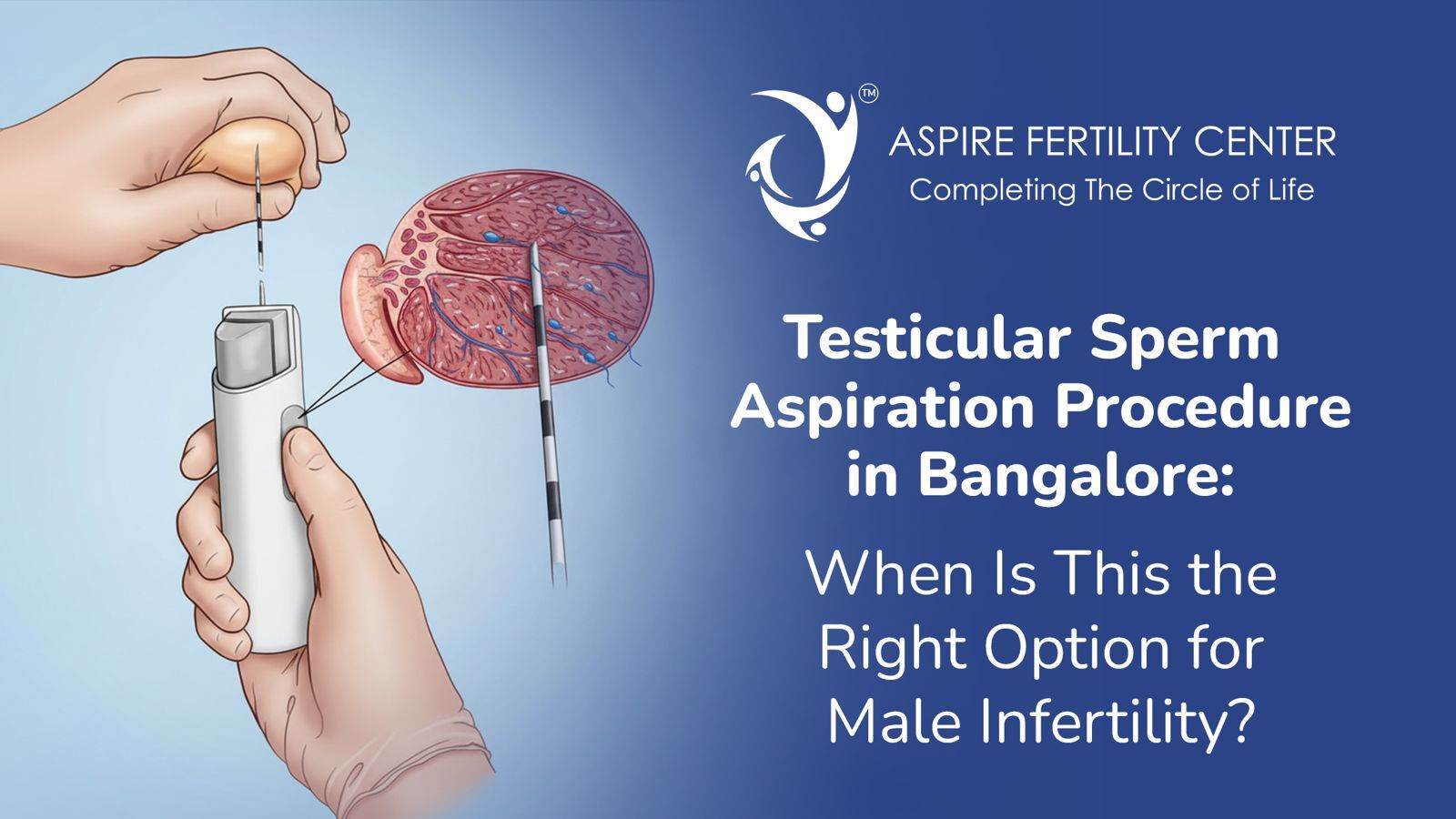
Male infertility contributes to approximately 40-50% of infertility cases among couples. Testicular Sperm Aspiration (TESA) is a medical procedure that retrieves sperm directly from the testicles when sperm is absent or insufficient in the ejaculation. This article explains the procedure, its indications, and the process at Aspire Fertility Center.
Understanding Male Infertility
Common Causes of Male Infertility
Male infertility results from several factors:
- Low sperm count or absent sperm in ejaculation (azoospermia)
- Poor sperm motility or abnormal morphology
- Blockages in the reproductive tract
- Genetic conditions
- Hormonal imbalances
- Previous infections, injuries, or surgeries
Diagnostic Testing for Male Infertility
Male Fertility Testing begins with a Semen Analysis Test in Bangalore, which measures:
- Sperm count (concentration)
- Sperm motility (movement)
- Sperm morphology (shape and structure)
Additional tests may include hormone panels and physical examinations. These results determine the appropriate male infertility treatment approach.
What Is Testicular Sperm Aspiration?
Procedure Overview
Testicular Sperm Aspiration is a minimally invasive technique that extracts sperm directly from testicular tissue using a fine needle. The procedure is indicated when sperm is absent in the ejaculate due to production issues or blockages.
The procedure:
- Takes 15-30 minutes
- Uses local anesthesia
- Involves needle insertion into the testicle to extract tissue containing sperm
- Results in no scarring
Comparison with Other Retrieval Methods
TESA differs from surgical sperm retrieval methods (TESE, micro-TESE) in that it does not require incisions. This results in shorter procedure time and faster recovery compared to surgical alternatives.
Medical Indications for Testicular Sperm Aspiration
Obstructive Azoospermia
Obstructive azoospermia occurs when sperm production is normal but physical blockages prevent sperm from entering the ejaculate. Causes include:
- Previous vasectomy
- Congenital absence of vas deferens
- Scarring from infections or injuries
- Surgical complications
Testicular Sperm Aspiration bypasses the blockage to retrieve viable sperm for assisted reproduction.
Non-Obstructive Azoospermia
Non-obstructive azoospermia involves impaired sperm production within the testicles. While more challenging, TESA can identify areas where limited sperm production occurs. Success rates are lower than with obstructive cases.
Failed Vasectomy Reversal
When vasectomy reversal surgery does not restore sperm to the ejaculate, Testicular Sperm Aspiration provides an alternative for sperm retrieval.
Ejaculatory Dysfunction
Men with ejaculatory problems due to spinal cord injury, diabetes, or retrograde ejaculation may require TESA when sperm production is normal but ejaculation is impaired.
The TESA Process at Aspire Fertility Center
Initial Evaluation
The process begins with:
- Comprehensive medical history review
- Semen Analysis Test in Bangalore
- Hormone level assessment
- Physical examination
- Discussion of Male Fertility Testing results
These evaluations determine if Testicular Sperm Aspiration is medically appropriate.
Procedure Day
On the day of the procedure:
- Local anesthesia is administered to the scrotal area
- A fine needle is inserted into the testicle
- Tissue samples containing sperm are extracted
- Samples are immediately processed in the laboratory
Most patients report minimal to moderate discomfort during the procedure.
Post-Procedure Care
After Testicular Sperm Aspiration:
- Mild swelling and discomfort may occur for 2-5 days
- Supportive underwear is recommended
- Avoid strenuous activity for one week
- Over-the-counter pain relief may be used as directed
Retrieved sperm is either used immediately for fertilization or cryopreserved for future use.
Use in Assisted Reproductive Technology
ICSI and IVF
Sperm obtained through Testicular Sperm Aspiration is typically used with Intracytoplasmic Sperm Injection (ICSI), where a single sperm is injected directly into an egg. This technique is necessary when sperm count or quality is limited.
The process involves:
- Egg retrieval from the female partner
- Sperm selection and preparation
- Direct injection of sperm into each egg
- Embryo culture and transfer
Success Factors
Pregnancy success rates with TESA-retrieved sperm depend on:
- Type of azoospermia (obstructive vs non-obstructive)
- Sperm quality and quantity obtained
- Female partner’s age and ovarian reserve
- Egg quality
- Embryo development quality
Obstructive azoospermia cases generally have higher success rates than non-obstructive cases.
Aspire Fertility Center: Facilities and Expertise
Medical Leadership
Aspire Fertility Center is led by Dr. Ashwini G. B., Founder and Clinical Director, who specializes in Reproductive Medicine. The center’s team includes fertility specialists and andrologists experienced in male infertility treatment and sperm retrieval procedures.
Laboratory Capabilities
The center maintains:
- Andrology laboratory for sperm processing
- Cryopreservation facilities for sperm storage
- Embryology laboratory for IVF/ICSI procedures
- Quality control protocols for sample handling
Patient Evaluation Process
Each patient receives:
- Detailed diagnostic testing including Semen Analysis Test in Bangalore
- Review of Male Fertility Testing results
- Discussion of treatment options based on diagnosis
- Individualized treatment planning
Next Steps for Evaluation
Patients experiencing male infertility or diagnosed with azoospermia can schedule a consultation to determine if Testicular Sperm Aspiration is appropriate. The evaluation includes comprehensive Male Fertility Testing and discussion of all available male infertility treatment options.
Contact Aspire Fertility Center
Phone:
- 080-42121313
- 9620004610
- 9620006410
Email:
- info@aspirefertility.in
Locations:
HSR Layout: No 2, 19th Main, 4th Sector, HSR Layout, Bangalore 560102
Sarjapur-Marathahalli: 4th Floor, Within NATUS Hospital, 20/13, Sarjapur – Marathahalli Rd, Carmelaram, Janatha Colony, Doddakannelli, Bengaluru, Karnataka 560035
Conclusion
Testicular Sperm Aspiration is a medical procedure for retrieving sperm when it is absent from the ejaculate. The technique is indicated for obstructive azoospermia, non-obstructive azoospermia, failed vasectomy reversal, and ejaculatory dysfunction. Combined with ICSI, TESA-retrieved sperm can be used for assisted reproduction. Success depends on the underlying cause of azoospermia and other fertility factors in both partners.
Frequently Asked Questions
Q1: What level of pain is associated with Testicular Sperm Aspiration?
A1: The procedure uses local anesthesia, which numbs the scrotal area. During the procedure, patients typically feel pressure or mild discomfort but not sharp pain. Post-procedure pain is generally mild to moderate and can be managed with paracetamol tablets as needed. Swelling and tenderness typically resolve within 3-5 days.
Q2: What is the recovery timeline after TESA?
A2: Most patients resume normal daily activities within 1-2 days. Specific recovery guidelines include avoiding heavy lifting for one week, avoiding strenuous exercise for one week, and wearing supportive underwear for several days. Minor bruising and swelling are normal and typically resolve within one week.
Q3: What are the success rates for pregnancy using TESA-retrieved sperm?
A3: Success rates vary based on the type of azoospermia. Obstructive azoospermia has fertilization rates of 50-70% and clinical pregnancy rates comparable to standard IVF/ICSI. Non-obstructive azoospermia has lower success rates due to limited sperm availability and potential quality issues. Female partner age and egg quality also significantly impact outcomes. Success rates are discussed during consultation based on individual diagnostic findings.
Q4: Can sperm from TESA be frozen for later use?
A4: Yes, sperm retrieved through Testicular Sperm Aspiration can be cryopreserved. Frozen sperm remains viable for years when properly stored. This eliminates the need to repeat the procedure for subsequent IVF/ICSI cycles. Cryopreservation is particularly beneficial when multiple treatment cycles may be needed.
Q5: How is candidacy for Testicular Sperm Aspiration determined?
A5: Candidacy is determined through Male Fertility Testing, which includes a Semen Analysis Test in Bangalore to confirm azoospermia, hormone testing to assess testicular function, physical examination, and medical history review. TESA is considered when diagnostic testing shows azoospermia (no sperm in ejaculate), documented blockages in the reproductive tract, failed vasectomy reversal, or ejaculatory dysfunction with normal sperm production. A fertility specialist reviews all test results to determine if TESA is the appropriate male infertility treatment option.

