
A balanced translocation is a rearrangement of chromosomes in which no genetic material is lost or gained. The person who has it, called a translocation carrier, is usually healthy. However, a balanced translocation can cause repeated miscarriage when an egg or sperm carries too much or too little chromosome material. Options for a translocation carrier include trying naturally, IVF with preimplantation genetic testing for structural rearrangements (PGT-SR), and donor gametes. This guide from Aspire Fertility Center explains each option, including IVF for translocation carriers in Bangalore.
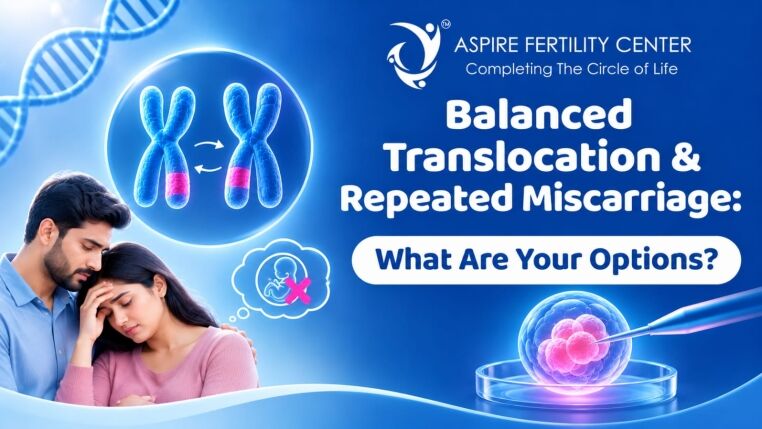
Table of Contents
What Is a Balanced Translocation?
What does “balanced” mean?
Chromosomes are the structures in cells that carry genes. Most people have 46, in 23 pairs. In a balanced translocation, two chromosomes exchange or join pieces. All genetic material is still present, only in a new arrangement. Because nothing is missing, most carriers have no symptoms and often learn of the change only after repeated pregnancy loss.
What are the main types?
- Reciprocal translocation: two different chromosomes exchange pieces.
- Robertsonian translocation: two chromosomes (from 13, 14, 15, 21 or 22) fuse into one.
Who is a translocation carrier?
A translocation carrier is a person with a balanced translocation. Either partner can be the carrier. The change may be inherited from a parent or may arise for the first time in that person. It is not caused by anything a person did or did not do.
How Does a Balanced Translocation Cause Repeated Miscarriage?
What happens when eggs and sperm form?
Eggs and sperm form when a cell’s chromosomes are divided in half. In a translocation carrier, the rearranged chromosomes do not always divide evenly. An egg or sperm may therefore have an extra or missing piece of chromosome.
What are balanced and unbalanced embryos?
An embryo formed from such an egg or sperm falls into one of three groups:
- Normal: the usual amount of chromosome material.
- Balanced: the same rearrangement as the carrier parent, usually without health effects.
- Unbalanced: extra or missing chromosome material.
Unbalanced embryos often stop developing, which results in miscarriage. Rarely, an unbalanced pregnancy continues, and the baby has health or developmental problems.
How common is it in couples with repeated miscarriage?
Balanced chromosome changes are reported in about 1 in 30 couples with recurrent pregnancy loss, defined by ESHRE as the loss of two or more pregnancies. In most couples the cause is different or is not found.
How Is a Balanced Translocation Diagnosed?
What is a karyotype test, and who needs it?
A karyotype is a blood test that shows the number and structure of chromosomes. ESHRE guidance does not recommend it for every couple with repeated miscarriage. Doctors decide after reviewing the history. A karyotype is more likely to be advised after a birth with a congenital anomaly, or when a chromosome change is found in miscarriage tissue or a prenatal sample. Couples with an abnormal karyotype should receive genetic counselling.
What other tests are done for repeated miscarriage?
A balanced translocation is one possible cause among several. Evaluation usually includes a uterine scan (and hysteroscopy if needed), thyroid and hormone tests, blood sugar, clotting tests, and semen analysis for the male partner. At Aspire Fertility Center, female infertility treatment in Bangalore starts with this full evaluation. For more on causes, see our guide to recurrent pregnancy loss.
What Are the Options for a Translocation Carrier?
The suitable option depends on age, number of past losses, egg reserve, the type of translocation, and personal preference.
Can a translocation carrier conceive naturally?
Yes. Many carriers conceive naturally and have healthy babies. The chance of miscarriage in each pregnancy is higher than average. Early scans and prenatal diagnostic tests, such as CVS or amniocentesis, can check the baby’s chromosomes.
What is IVF with PGT-SR?
In IVF with PGT-SR, embryos are created in the lab and tested before transfer. The test shows whether an embryo has the expected amount of chromosome material. Only such embryos are considered for transfer.
When are donor eggs or sperm considered?
Donor gametes may be discussed if a carrier’s eggs or sperm repeatedly produce unbalanced embryos. The donor does not carry the translocation, so it is not passed on through the embryo. Donor use is regulated by India’s ART Act. Adoption is another option, and the choice is personal.
How Does IVF for Translocation Carriers in Bangalore Work at Aspire?
IVF for translocation carriers in Bangalore combines standard IVF with preimplantation genetic testing.
What are the steps?
- Consultation and genetic counselling: review of karyotype reports and pregnancy history.
- Ovarian stimulation and egg retrieval: medicines mature several eggs, which are collected in a short procedure.
- Fertilisation and embryo culture: eggs are fertilised, often by ICSI, and embryos grow for about 5 to 6 days.
- Embryo biopsy: a few cells are taken from the outer layer of each embryo.
- Genetic testing: embryos are frozen while results are prepared.
- Frozen embryo transfer: an embryo with the expected chromosome material is placed in the uterus.
The timeline depends on the protocol and the testing turnaround. Your doctor will give an estimate.
What can PGT-SR do, and what can it not do?
PGT-SR identifies embryos with extra or missing chromosome material. According to the ESHRE guideline, it can reduce the miscarriage rate but does not improve the live birth rate or the time to pregnancy. Some cycles produce no embryo suitable for transfer, and pregnancy is not guaranteed. Prenatal testing may still be advised after conception.
Some embryos will be balanced, like the carrier parent. They are generally expected to be healthy but carry the same translocation. This is covered in counselling. Sex selection is not permitted under Indian law, and PGT-SR is not used for it. To compare test types, see PGT-M vs PGT-A.
Does age affect the outcome?
Egg numbers and quality decline with age, which can mean fewer embryos to test. Ovarian reserve is assessed with blood tests and a scan before treatment is planned. This assessment is part of female infertility treatment in Bangalore at Aspire Fertility Center.
Who Will Guide Your Care at Aspire Fertility Center?
Aspire Fertility Center is led by Dr. Ashwini G. B., Founder & Clinical Director. Her qualifications are MBBS, MS (OBG) and FIRM, and she is an ESHRE-certified Clinical Embryologist. Embryology training is relevant to this topic because embryo culture and biopsy are laboratory steps in a PGT-SR cycle.
The team of doctors and fertility specialists at Aspire Fertility Center has experience across reproductive medicine. For couples with a balanced translocation, the team reviews karyotype reports and pregnancy history together before recommending an option.
When Should You See a Specialist?
Book a consultation if:
- You have had two or more pregnancy losses.
- A balanced translocation runs in your family.
- A karyotype report shows a chromosome change.
- A past pregnancy was affected by a chromosome condition.
Conclusion
A balanced translocation does not rule out a healthy baby, but it usually calls for extra testing and planning. The options are trying naturally with monitoring, IVF with PGT-SR, or donor gametes. Whether you need IVF for translocation carriers in Bangalore or wider female infertility treatment in Bangalore, the first step is a diagnosis and a counselling session on your options.
FAQs
Q1: Can a balanced translocation carrier have a healthy baby?
A1: Yes. Many carriers have healthy babies, either naturally or with IVF and PGT-SR. The risk of miscarriage in each pregnancy is higher, so close monitoring is usually advised.
Q2: Is a balanced translocation inherited?
A2: It can be inherited from a parent, or it can arise for the first time in the carrier. A karyotype shows the type of change. A carrier can pass the translocation to a child.
Q3: Does a balanced translocation affect the carrier’s own health?
A3: Usually not, because no genetic material is lost. Rarely, the break point disrupts a gene and causes a health issue. A doctor can review the report for this.
Q4: Is IVF with PGT-SR the only option?
A4: No. Trying naturally, IVF with PGT-SR, and donor eggs or sperm are all possible. The choice depends on age, past losses, egg reserve and preference.
Q5: How long does IVF with PGT-SR take?
A5: It depends on the protocol, the number of embryos obtained and the lab’s testing time. Some people need more than one stimulation cycle to get embryos suitable for transfer. Your doctor can give an estimate after assessment.
Contact Aspire Fertility Center
Call us: 080-42121313 | 9620004610 | 9620006410 Email: info@aspirefertility.in
Visit our centers:
- Site No 2, 19th Main Rd, 4th Sector, HSR Layout, Bengaluru, Karnataka 560102
- Sarjapur-Marathahalli: 4th Floor, Within NATUS Hospital, 20/13, Sarjapur – Marathahalli Rd, Carmelaram, Janatha Colony, Doddakannelli, Bengaluru, Karnataka 560035
- Aspire Fertility Center, 1st floor, ASN Signature building Varthur Main Rd, near Laughing Waters Siddapura, Ramagondanahalli, Bengaluru, Karnataka 560066

