
If you’re exploring genetic testing options during IVF, you’ve likely come across both PGT-A and PGT-M and wondered how they differ. The similar-sounding names don’t help, and it’s easy to assume they’re interchangeable when they’re actually designed for very different purposes. Understanding PGT-M vs PGT-A isn’t just a technical detail — it directly shapes which test is relevant to your specific situation. At Aspire Fertility Center, we believe this decision should be clear, not confusing. This blog breaks down what each test does and how to know which one applies to you.
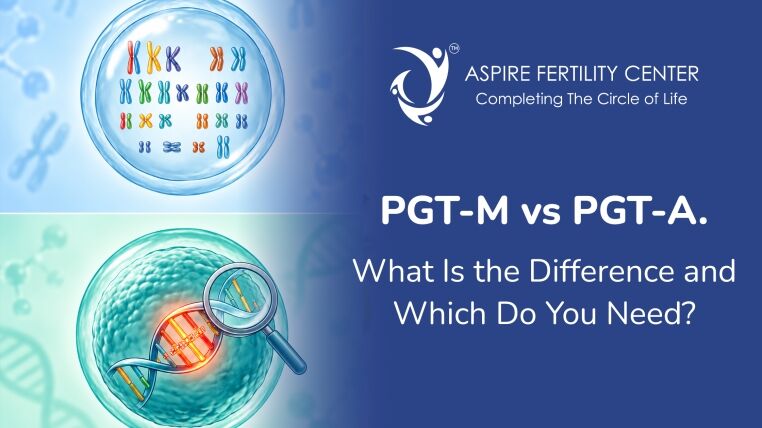
PGT-M vs PGT-A: What Do These Tests Actually Check?
PGT-M vs PGT-A comes down to two very different purposes, even though both are genetic tests performed on embryos during IVF.
What Is PGT-A?
PGT-A screens embryos for an abnormal number of chromosomes, known as aneuploidy — meaning extra or missing chromosomes. This helps improve implantation chances and reduce the risk of miscarriage by identifying embryos with the correct chromosomal count.
What Is PGT-M?
PGT-M, on the other hand, tests for specific inherited single-gene conditions that run in families. Rather than checking the overall chromosome count, it looks for a known genetic mutation tied to a particular condition that a parent carries or is at risk of passing on. This makes PGT-M a highly specific test, used only when there’s a defined genetic concern to screen for.
Chromosomal vs Monogenic Testing — Understanding the Core Difference
Chromosomal vs monogenic testing is really the heart of the PGT-M vs PGT-A distinction, and understanding this difference makes the rest of the decision much clearer.
Chromosomal Testing (PGT-A) Explained
Chromosomal vs monogenic testing starts with PGT-A, which falls into the chromosomal category. It looks broadly at whether an embryo has the right number of chromosomes overall, without targeting any one specific gene or condition. This makes it a general screening tool relevant to a wide range of patients.
Monogenic Testing (PGT-M) Explained
On the other side of chromosomal vs monogenic testing is PGT-M, which is far more targeted. It’s designed specifically for families with a known inherited condition, testing embryos for that particular gene mutation rather than screening chromosomes as a whole.
IVF Genetic Testing Types — Where PGT-SR and Other Lab Tools Fit In
Beyond PGT-M vs PGT-A, there are other IVF genetic testing types and lab technologies worth knowing about, even if they’re less commonly discussed.
PGT-SR — Testing for Structural Rearrangements
Among the IVF genetic testing types, PGT-SR screens for structural rearrangements in chromosomes. This is typically relevant for couples where one partner carries a known chromosomal rearrangement, which can affect embryo viability in specific ways that differ from standard aneuploidy. Like PGT-M, this test is only relevant when there’s a known structural concern identified beforehand, rather than being a general screening option.
Complementary Lab Technologies
It’s worth noting that not everything offered alongside IVF genetic testing types is itself a genetic test. Time-lapse imaging allows embryologists to monitor embryo development without disturbing the embryo, while assisted hatching is a laser-based technique that helps the embryo hatch from its outer shell. These are valuable lab tools, but they work alongside genetic testing rather than replacing it.
PGT-M vs PGT-A: Which Do You Need?
Deciding between PGT-M vs PGT-A — or determining if you need both — depends entirely on your individual and family medical history.
When PGT-A Is Recommended
PGT-A is often recommended for a broad range of IVF patients, particularly those of advanced maternal age or with a history of recurrent miscarriage, since chromosomal abnormalities become more common in these situations. It doesn’t require a known family history to be relevant, which is part of why it applies to a wider group of patients.
When PGT-M Is Recommended
PGT-M is recommended specifically when a parent is a known carrier of an inherited genetic condition, and the goal is to avoid passing that specific condition on to the child. This makes it a much more targeted, family-history-driven decision compared to PGT-A.
Can You Need Both?
In some cases, yes. A couple with both advanced maternal age and a known inherited condition in the family may benefit from combining PGT-M vs PGT-A testing on the same embryos, giving a more complete picture before deciding which embryo to transfer.
How Aspire Fertility Center Supports Your Genetic Testing Decisions
At Aspire Fertility Center, we understand that choosing between PGT-M vs PGT-A — or realizing you may need both — can feel overwhelming without clear guidance.
As the best fertility clinic in Bangalore for personalized genetic testing counseling, we help patients understand exactly which test, or combination of tests, fits their specific medical and family history. Being recognized as the best fertility clinic in Bangalore means never recommending a test simply because it’s available, but because it’s genuinely relevant to your situation.
Meet Our Founder & Clinical Director, Dr. Ashwini G. B.
Aspire Fertility Center is led by Dr. Ashwini G. B., our Founder & Clinical Director. She and our team of fertility specialists work across various fields of reproductive medicine, including genetic testing counseling and personalized IVF planning. Our team believes every patient deserves a clear explanation of PGT-M vs PGT-A before making a decision, not just a list of available add-ons.
For a helpful overview of these lab technologies, check out this Instagram reel from our page, where Dr. Ashwini walks through PGT-A, PGT-M, PGT-SR, and other advanced embryo lab tools.
If you’re unsure which genetic test applies to your IVF journey, book a consultation with Dr. Ashwini G.B. at Aspire Fertility Center — a best fertility clinic in Bangalore for clear, individualized genetic testing guidance.
Visit Aspire Fertility Center
Call us: 080-42121313 | 9620004610 | 9620006410 Email: info@aspirefertility.in
HSR Layout Center: Site No 2, 19th Main Rd, 4th Sector, HSR Layout, Bengaluru, Karnataka 560102
Sarjapur-Marathahalli Center: 4th Floor, Within NATUS Hospital, 20/13, Sarjapur – Marathahalli Rd, Carmelaram, Janatha Colony, Doddakannelli, Bengaluru, Karnataka 560035
Conclusion
Understanding PGT-M vs PGT-A comes down to recognizing their different purposes — chromosomal vs monogenic testing serves very different needs, and knowing which applies to you starts with your personal and family medical history. Whether you need PGT-A, PGT-M, or both, having this clarity before your IVF cycle makes a real difference. At Aspire Fertility Center, we’re here to guide that decision with you, step by step.
Frequently Asked Questions
Q1: What is the main difference in PGT-M vs PGT-A?
A1: PGT-M vs PGT-A differ in purpose — PGT-A screens for an abnormal number of chromosomes, while PGT-M tests for a specific inherited single-gene condition known to run in a family.
Q2: How does chromosomal vs monogenic testing affect which test I need?
A2: Chromosomal vs monogenic testing determines the right test based on your situation — PGT-A (chromosomal) suits general screening needs, while PGT-M (monogenic) is needed only if a specific inherited condition runs in your family.
Q3: What are the main IVF genetic testing types available?
A3: The main IVF genetic testing types include PGT-A for chromosome screening, PGT-M for inherited single-gene conditions, and PGT-SR for structural chromosomal rearrangements.
Q4: Can I need both PGT-A and PGT-M?
A4: Yes, some patients may benefit from both, particularly if they have both advanced maternal age and a known inherited condition in the family. Your doctor can help determine if combined testing is right for you.
Q5: Is PGT-SR the same as PGT-A or PGT-M?
A5: No, PGT-SR is a separate test that screens for structural rearrangements in chromosomes, typically relevant for couples where one partner carries a known chromosomal rearrangement.
