
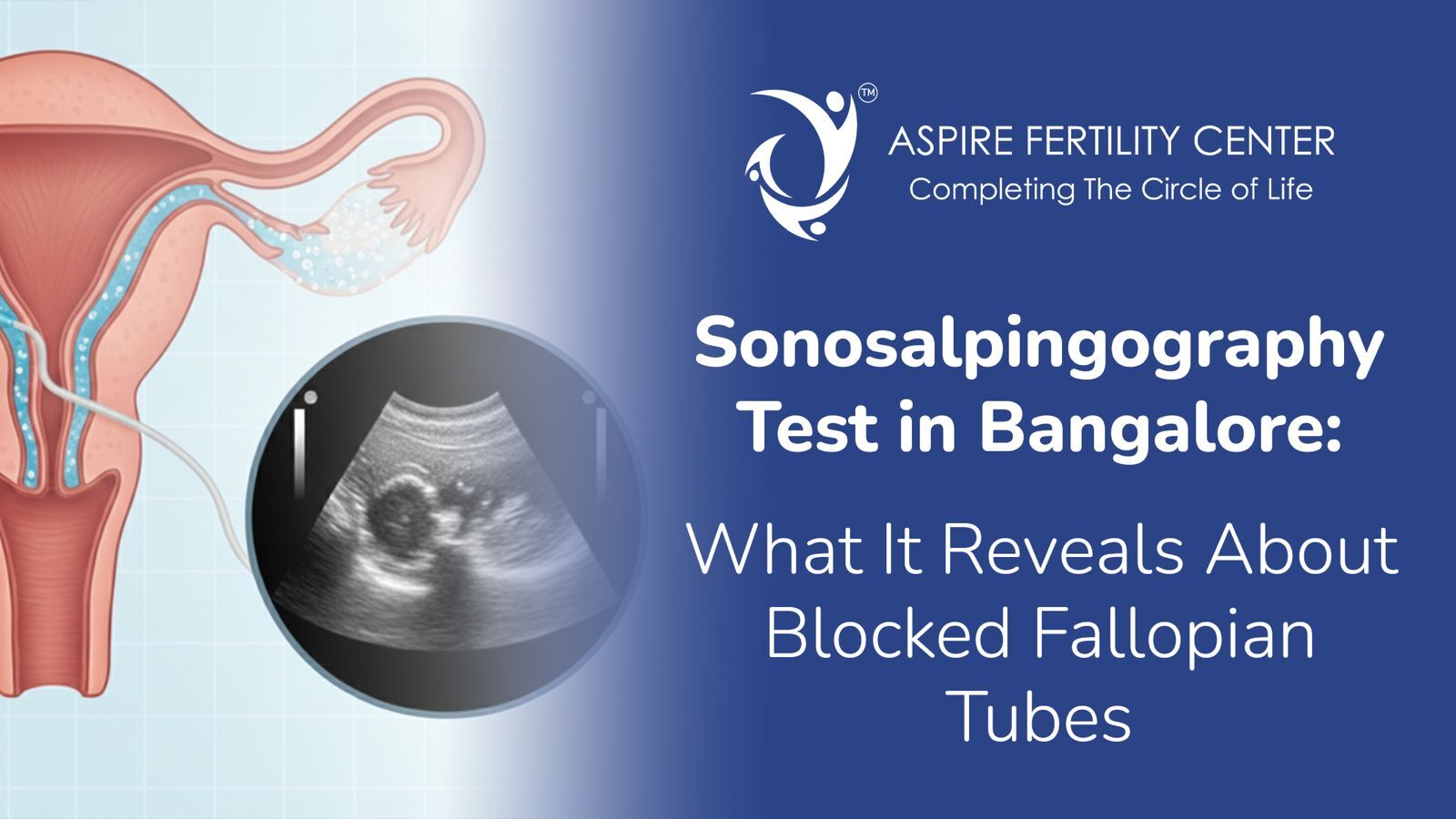
Fallopian tube blockages account for approximately 25-30% of female infertility cases. The sonosalpingography test is an ultrasound-based diagnostic procedure that checks whether your fallopian tubes are open or blocked. This test uses sound waves and contrast solution to visualize your fallopian tubes and uterine cavity without radiation exposure.
This guide explains what the sonosalpingography test involves, what it can detect, and how it helps diagnose fallopian tube blockage.
What Is a Sonosalpingography Test?
Definition and Purpose
Sonosalpingography, also called HyCoSy (Hysterosalpingo-Contrast-Sonography), is an ultrasound examination of the fallopian tubes and uterine cavity. The procedure uses transvaginal ultrasound combined with a contrast solution to determine if the fallopian tubes are open (patent) or blocked.
During the test, a sterile saline solution with contrast bubbles is injected through the cervix. The ultrasound tracks the fluid’s movement through the uterus and fallopian tubes in real-time.
Comparison with HSG
The sonosalpingography procedure differs from Hysterosalpingogram (HSG) in several ways:
- Sonosalpingography uses ultrasound; HSG uses X-ray imaging
- Sonosalpingography has no radiation exposure
- Both tests assess fallopian tube patency with similar accuracy rates
- Sonosalpingography typically causes less discomfort than HSG
Why Fallopian Tube Health Matters for Fertility
Function of Fallopian Tubes
The fallopian tubes serve three essential functions in natural conception:
- They provide the site where sperm and egg meet for fertilization
- They nourish the early embryo during the first few days after fertilization
- They transport the embryo to the uterus for implantation
When one or both fallopian tubes are blocked, sperm cannot reach the egg.
Common Causes of Blockage
Fallopian tube blockage can result from:
- Pelvic inflammatory disease (PID) from sexually transmitted infections
- Endometriosis causing adhesions or scar tissue
- Previous pelvic or abdominal surgery
- Previous ectopic pregnancy
- Hydrosalpinx (fluid-filled, blocked tube)
Many women with blocked tubes have no symptoms. The blockage is often discovered only during fertility testing.
The Sonosalpingography Procedure: Step by Step
Preparation
The sonosalpingography test is scheduled between days 7-10 of your menstrual cycle. This timing occurs after menstruation ends but before ovulation, reducing the risk of affecting the chances of pregnancy and providing optimal imaging conditions.
Pre-procedure requirements:
- Take over-the-counter pain medication (ibuprofen 400-600mg) 30-60 minutes before the test
- Empty your bladder before the procedure
- Avoid scheduling if you have an active pelvic infection
During the Test
The sonosalpingography procedure takes 15-30 minutes and includes these steps:
- You lie on an examination table in a position similar to a pelvic exam
- A speculum is inserted, and the cervix is cleaned
- A thin catheter is placed through the cervix into the uterus
- A transvaginal ultrasound probe is inserted
- Sterile saline solution with contrast bubbles is slowly injected through the catheter
- The ultrasound monitors the fluid as it flows through the uterus and fallopian tubes
If tubes are open, fluid spills into the pelvic cavity. If blocked, the fluid stops at the blockage point.
Most women experience mild to moderate cramping during contrast injection. Pain intensity varies but is generally comparable to menstrual cramps.
After the Test
Post-procedure expectations:
- Light spotting or watery discharge for 1-2 days
- Mild cramping that resolves within 24 hours
- Resume normal activities the next day
- Results are available immediately
Contact your doctor if you experience fever, severe pain, or heavy bleeding.
What the Sonosalpingography Test Reveals
Tubal Patency Assessment
The test determines:
- Whether each fallopian tube is open (patent) or blocked
- The location of any blockage (proximal, mid-tube, or distal)
- Whether blockage is complete or partial
- Presence of hydrosalpinx (fluid-filled blocked tube)
Possible findings include:
- Both tubes open (bilateral patency)
- One tube open, one blocked (unilateral blockage)
- Both tubes blocked (bilateral blockage)
Additional Diagnostic Information
Beyond tubal assessment, the sonosalpingography test can identify:
- Uterine cavity shape and size abnormalities
- Uterine polyps or fibroids
- Intrauterine adhesions (Asherman’s syndrome)
- Congenital uterine anomalies (septate, bicornuate, or unicornuate uterus)
Benefits of Choosing Sonosalpingography
Safety Profile
Advantages compared to HSG:
- No ionizing radiation exposure
- Lower risk of allergic reaction (uses saline vs. iodine-based contrast)
- Reduced infection risk (antibiotic prophylaxis rarely needed)
- Lower pain scores reported in comparative studies
The procedure is performed as an outpatient test with same-day discharge.
Diagnostic Accuracy
Clinical effectiveness:
- Sensitivity for detecting tubal patency: 85-92%
- Specificity: 89-95%
- Real-time visualization allows immediate assessment
- Can identify specific blockage location
Cost Considerations
Sonosalpingography is generally less expensive than laparoscopy with chromopertubation, though costs vary by facility. The test provides diagnostic information without requiring surgical intervention.
Treatment Options Based on Results
If Tubes Are Open
When both fallopian tubes are patent, further evaluation may examine:
- Ovulation disorders (hormonal testing, ultrasound monitoring)
- Male factor infertility (semen analysis)
- Unexplained infertility factors
Treatment options may include ovulation induction, intrauterine insemination (IUI), or timed intercourse.
If Blockages Are Found
Treatment depends on blockage type and location:
Proximal blockage (near the uterus):
- Selective tubal cannulation
- IVF (in vitro fertilization)
Distal blockage or hydrosalpinx:
- Laparoscopic surgery (salpingostomy or fimbrioplasty)
- Salpingectomy before IVF (if hydrosalpinx present)
- IVF without surgery
Bilateral complete blockage:
- IVF is the primary treatment option
IVF bypasses the fallopian tubes entirely by fertilizing eggs outside the body and transferring embryos directly to the uterus. For advanced fertility treatments, consulting the Best IVF centre in Bangalore can provide access to specialized care and technology. Success rates vary based on age, ovarian reserve, and other fertility factors.
About Aspire Fertility Center
Aspire Fertility Center is led by Dr. Ashwini G. B., Founder and Clinical Director. The center offers fertility diagnostic services including sonosalpingography testing and treatment options for infertility in Bangalore.
The team includes doctors and specialists trained in reproductive medicine who perform diagnostic procedures and interpret results for treatment planning.
Why Choose Aspire Fertility Center
Aspire Fertility Center is the Best IVF centre in Bangalore offering:
- Sonosalpingography testing with ultrasound equipment
- Same-day results and consultation
- Treatment options including IVF, IUI, and surgical interventions
- Two locations in Bangalore (HSR Layout and Sarjapur-Marathahalli)
Conclusion
The sonosalpingography test is an ultrasound-based diagnostic procedure that assesses fallopian tube patency and uterine cavity abnormalities. The test helps identify the cause of infertility in women and determines appropriate treatment options.
If you have been unable to conceive and need fallopian tube evaluation, consult with a fertility specialist to determine if sonosalpingography is appropriate for your situation.
Aspire Fertility Center, the Best IVF centre in Bangalore, performs sonosalpingography testing and provides fertility treatment services at two locations in the city.
Contact Aspire Fertility Center
To schedule a sonosalpingography test or fertility consultation:
Phone:
- 080-42121313
- 9620004610
- 9620006410
Email: info@aspirefertility.in
Locations:
HSR Layout: No 2, 19th Main, 4th Sector, HSR Layout, Bangalore 560102
Sarjapur-Marathahalli: 4th Floor, Within NATUS Hospital, 20/13, Sarjapur – Marathahalli Rd, Carmelaram, Janatha Colony, Doddakannelli, Bengaluru, Karnataka 560035
Frequently Asked Questions
Q1: Is the sonosalpingography test painful?
A1: Pain levels vary among patients. Most women experience mild to moderate cramping during the contrast injection, similar in intensity to menstrual cramps. Some women report minimal discomfort, while others find it more uncomfortable. Taking ibuprofen 400-600mg approximately 30-60 minutes before the procedure can reduce cramping. Pain typically subsides within a few hours after the test.
Q2: How long does it take to get results from the sonosalpingography test?
A2: Results are available immediately. The doctor can see whether your fallopian tubes are open or blocked during the real-time ultrasound imaging. You will receive your results and discuss them with your doctor before leaving the hospital.
Q3: Can the sonosalpingography test treat blocked fallopian tubes?
A3: The sonosalpingography test is diagnostic, not therapeutic. However, some studies suggest the procedure may temporarily improve fertility in a small percentage of women, possibly by flushing out minor debris or mucus plugs. This effect is not guaranteed and should not be expected. If significant blockages are detected, your doctor will discuss appropriate treatment options such as surgical intervention or IVF.
Q4: How soon after the test can I try to conceive?
A4: If no blockages are found, you can attempt conception in the same menstrual cycle after the sonosalpingography test. Some research indicates slightly higher pregnancy rates in the first 3-6 months following the procedure, though this finding is not consistent across all studies. Your doctor will provide specific recommendations based on your test results and overall fertility assessment.
Q5: What if I have a history of pelvic infections—can I still have this test?
A5: Active pelvic infection is a contraindication for sonosalpingography. The test should be postponed until the infection is fully treated. If you have a history of treated pelvic infections but no current infection, the test can be performed safely. Your doctor may prescribe prophylactic antibiotics if you have a history of recurrent pelvic inflammatory disease or other risk factors for infection. A complete medical history review will determine if the test is appropriate for your situation.
